
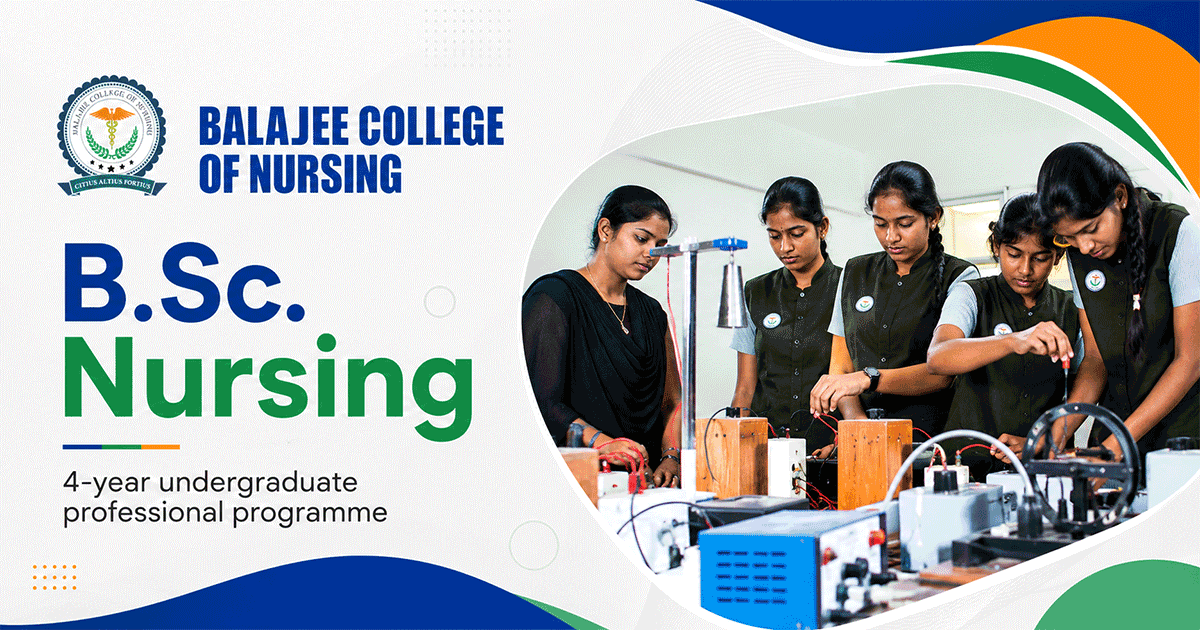
The Bachelor of Science in Nursing (B.Sc. Nursing) is a 4-year undergraduate professional degree programme designed to equip students with in-depth nursing knowledge, advanced clinical skills, and the practical experience required to provide high-quality patient care. The programme prepares students to become competent, compassionate, and ethical healthcare professionals capable of serving in hospitals, community health centres, educational institutions, and various healthcare organisations. The curriculum integrates theoretical learning, practical laboratory sessions, simulation-based training, community health exposure, and extensive clinical practice to ensure students gain hands-on experience in real-world healthcare environments. Students are trained in areas such as medical-surgical nursing, child health nursing, mental health nursing, obstetrics and gynaecological nursing, community health nursing, anatomy, physiology, microbiology, pharmacology, nutrition, pathology, and nursing research. Throughout the programme, students develop essential skills in patient assessment, diagnosis, treatment planning, medication administration, emergency care, infection control, critical thinking, communication, leadership, and healthcare management. The course also emphasises professional ethics, evidence-based nursing practices, patient safety, and holistic care, enabling graduates to meet the evolving demands of the healthcare industry.
Why Choose Us
FAQ's
1. What is the B.Sc. Nursing programme?
The Bachelor of Science in Nursing (B.Sc. Nursing) is a 4-year undergraduate professional degree programme that prepares students for a rewarding career in healthcare. The course combines classroom instruction, laboratory training, community health exposure, and extensive clinical practice to develop competent nursing professionals capable of providing quality patient care in hospitals, clinics, and community settings.
2. What is the eligibility for admission?
Candidates must have completed 10+2 / Intermediate with Physics, Chemistry, and Biology (BiPC) from a recognized board. Bridge Course candidates are also eligible as per Government regulations. Admissions are offered based on the eligibility criteria and guidelines prescribed by the competent authorities.
3. What subjects are taught during the programme?
The curriculum covers a wide range of nursing and medical science subjects, including Anatomy, Physiology, Biochemistry, Microbiology, Pathology, Pharmacology, Nutrition, Psychology, Medical-Surgical Nursing, Child Health Nursing, Mental Health Nursing, Community Health Nursing, Obstetrics & Gynaecological Nursing, Nursing Research, and Nursing Management. Students also participate in practical laboratory sessions and supervised clinical training.
4. Does the programme include practical and clinical training?
Yes. Clinical training is one of the most important components of the programme. Students gain hands-on experience through postings in multi-specialty hospitals, community health centres, primary healthcare facilities, and specialty departments under the supervision of experienced nursing faculty and healthcare professionals. This practical exposure helps students develop confidence, clinical skills, and professional competence.
5. What career opportunities are available after completing B.Sc. Nursing?
Graduates can pursue rewarding careers in government hospitals, private hospitals, nursing homes, multispecialty healthcare centres, community health organisations, rehabilitation centres, educational institutions, military healthcare services, NGOs, and international healthcare organisations. They can work as Staff Nurses, Clinical Nurses, ICU Nurses, Operation Theatre Nurses, Community Health Nurses, Nursing Educators, Nursing Supervisors, and Healthcare Administrators.
6. Can I pursue higher education after B.Sc. Nursing?
Yes. After graduation, students can pursue M.Sc. Nursing in various specializations such as Medical-Surgical Nursing, Child Health Nursing, Community Health Nursing, Obstetrics & Gynaecological Nursing, Psychiatric Nursing, and Critical Care Nursing. Graduates may also choose MBA in Hospital Administration, Master of Public Health (MPH), Clinical Research, Nurse Practitioner programmes, or doctoral studies (Ph.D.) to advance their careers.
7. Is B.Sc. Nursing a good career choice?
Yes. Nursing is one of the most respected and rapidly growing healthcare professions worldwide. With the increasing demand for qualified healthcare professionals, B.Sc. Nursing offers excellent job security, attractive salary packages, career advancement opportunities, and the chance to make a meaningful difference in patients’ lives. It is an ideal career for individuals who are passionate about healthcare and helping others.
8. Are there opportunities to work abroad after completing B.Sc. Nursing?
Yes. B.Sc. Nursing graduates are highly valued in countries such as the USA, UK, Canada, Australia, New Zealand, Ireland, and Gulf countries. After meeting the required licensing and language proficiency requirements of the respective country, graduates can explore excellent international career opportunities with competitive salaries and professional growth.
9. What skills will students develop during the programme?
The programme helps students develop a wide range of professional and personal skills, including patient assessment, clinical decision-making, medication administration, emergency care, communication, leadership, teamwork, critical thinking, problem-solving, infection control, healthcare management, and ethical nursing practice. These skills prepare graduates to work effectively in diverse healthcare environments.
10. Why should I choose this B.Sc. Nursing programme?
This programme provides a strong foundation in nursing education through experienced faculty, modern laboratories, simulation-based learning, clinical exposure, community health training, and comprehensive practical experience. Students receive holistic education that focuses on academic excellence, professional ethics, compassionate patient care, and career readiness, enabling them to become skilled nursing professionals capable of serving society and succeeding in the healthcare industry.